C++ 基础(4):函数和 Lambda
本文介绍了如何将函数作为可调用对象,并通过在创建可调用对象时捕获其上下文环境,更好地支持泛型编程。
Represent functions as variables.
History: Predicates
Predicate: boolean-valued function
Example.
bool isVowel(char c) {
    c = toupper(c);
    return c == 'A' || c == 'E' || c == 'I' || c == 'O' || c == 'U';
}
Idea: Passing functions to generalize an algorithm with user-defined behavior
template <typename It, typename Pred>
It find_pred(It first, It last, Pred pred) {
    for (auto it = first; it != last; ++it) {
        if (pred(*it)) return it;
    }
    return last;
}

std::string corlys = "Lord of the Tides";
auto it = find_pred(corlys.begin(), corlys.end(), isVowel);
In this example, Pred is a function pointer which is bool (*)(char), and can be any callable object that takes an element and returns bool.
Lambda functions
Problem: Functions pointers generalize poorly. For example, if we want to find a number less than . Now we have to write lessthan5(), lessthan6(), … for each number .
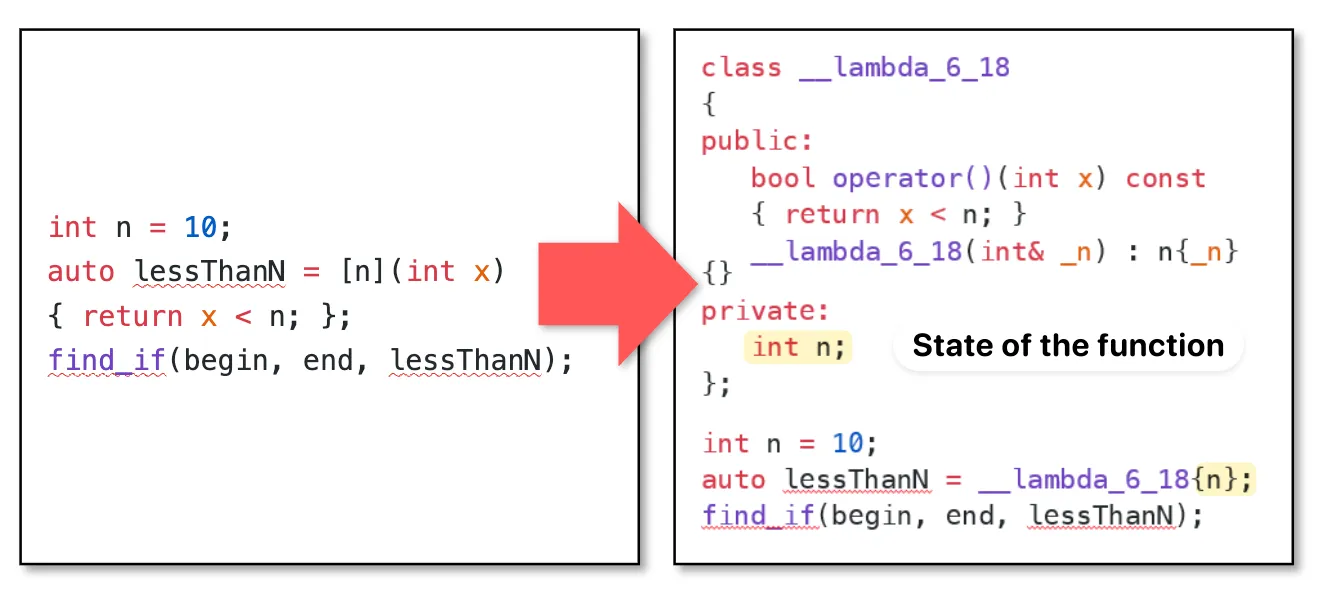
The is referred to as the state of the function. We need to give our function extra state (not introducing new parameters)
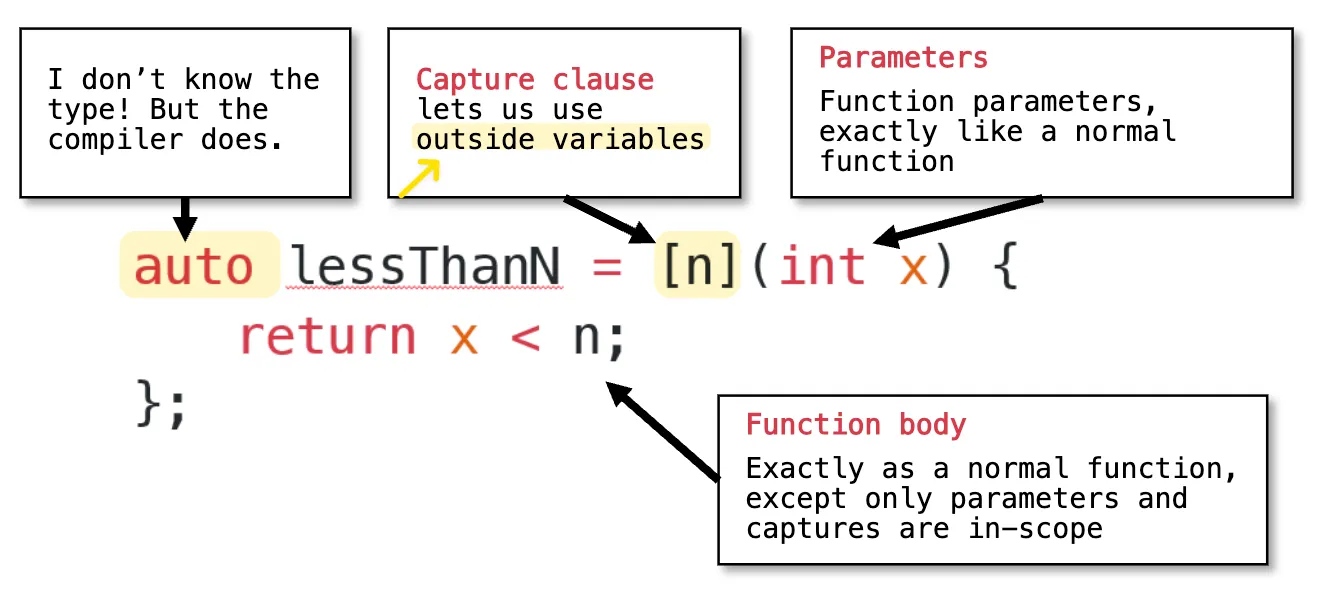 Lambda syntax. The only difference is the capture clause and the auto-deduction of the type of the return value.
Example.
std::vector<int> v = {1, 3, 5, 7, 9};
double n = avgVal(v); // calculate the avg value of the container

auto lessThanN = [n](int x) {
    return x < n;
};

int cnt = std::count_if(v.begin(), v.end(), lessThanN);
Captures
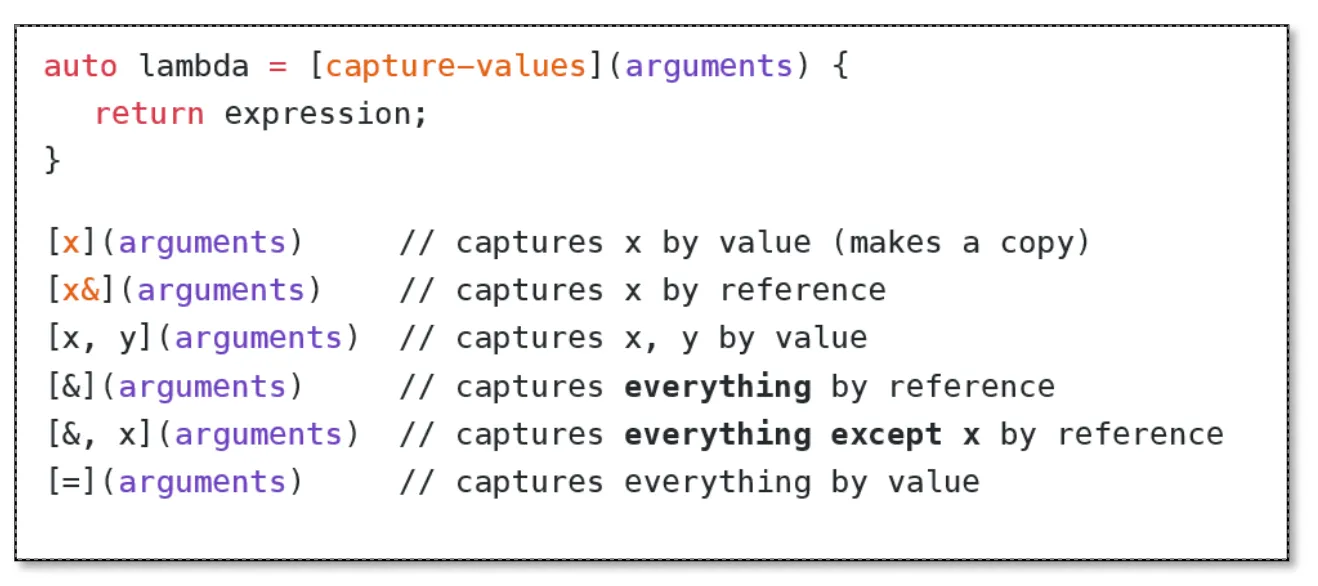
If we don’t need capture value, then use [] in the capture clause.
STL Functors
A functor is any object that defines an operator(). I.e., it is an object that acts like a function.
Since a functor is an object, it can have state
struct my_functor {
    bool operator()(int a) const {
        return a * value;
    }
    int value;
};

my_functor f;
f.value = 5;
std::cout << f(2) << std::endl;
Functors and lambda
When you use a lambda, a functor type is generated. It is a syntactic sugar